Korean Pet Names: 70+ Cute Names & K-Drama Nicknames (With Meanings)
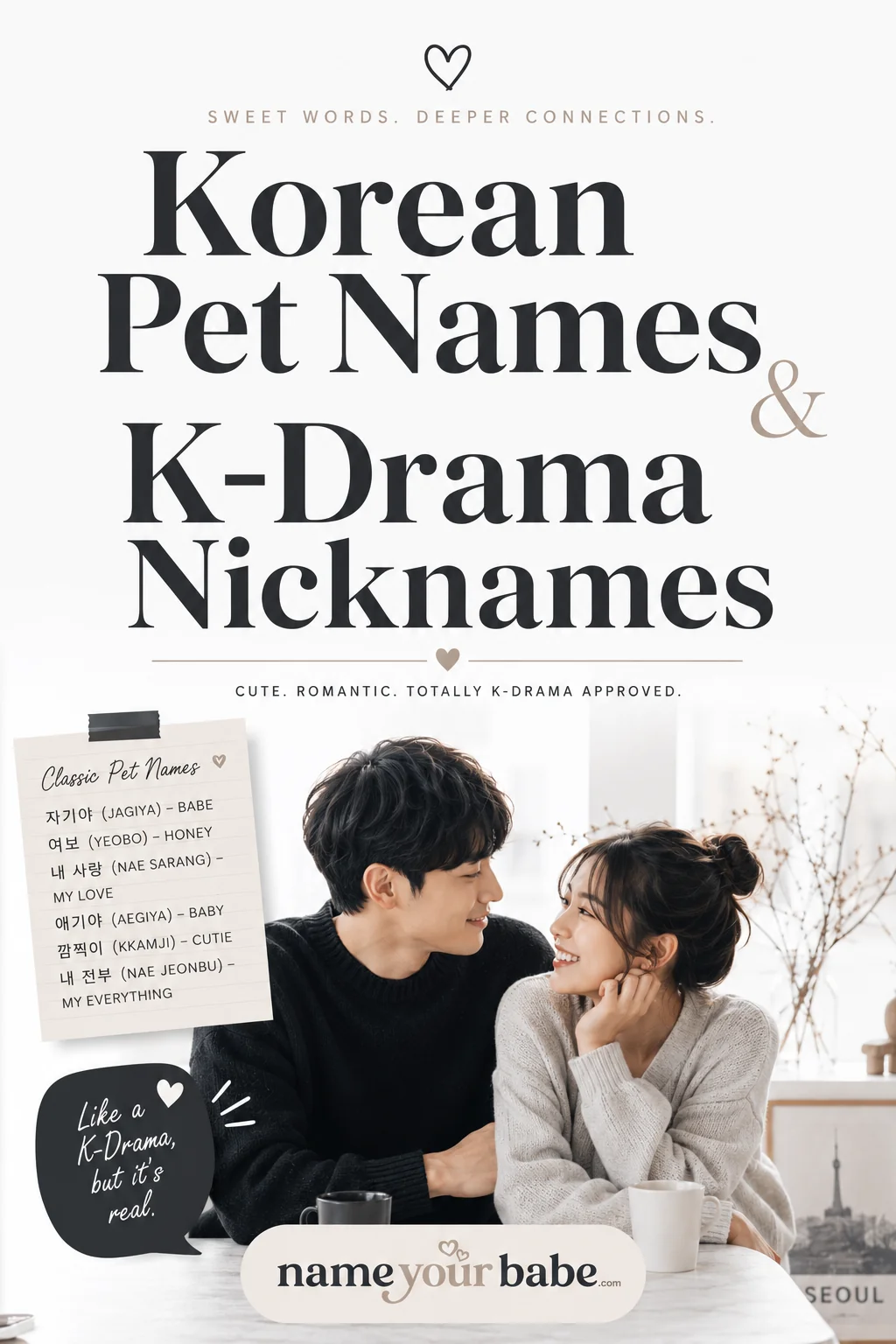
If you've fallen down the K-drama rabbit hole, you already know Korean has some of the most swoon-worthy terms of endearment anywhere — the soft "jagiya," the heart-fluttering "oppa," the way leads in dramas call each other names that make millions of viewers melt. Korean romance has a whole vocabulary, and it's gloriously cute.
This guide gives you 70+ Korean pet names and K-drama nicknames, each with its meaning, pronunciation, and Hangul (the Korean script), so you can use them right. Whether your partner is Korean, you're learning the language, or you just love K-dramas, here's how to add a little Korean sweetness to your love — jagiya and beyond.
The Essential Korean Pet Names
The core vocabulary of Korean affection:
- Jagiya (자기야) (JAH-gee-yah) — "honey/darling"; THE classic Korean couple term
- Jagi (자기) (JAH-gee) — the shorter, casual version
- Aein (애인) (AH-een) — "sweetheart/lover"
- Yeobo (여보) (YUH-bo) — "darling/honey" (used by married couples)
- Naekkeo (내꺼) (NEH-kuh) — "mine"
- Aegi (애기) (AH-gee) — "baby"
- Naesarang (내사랑) (NEH-sah-rang) — "my love"
- Gongju (공주) (GONG-joo) — "princess" (for her)
- Wangja (왕자) (WANG-jah) — "prince" (for him)
"Jagiya" is the one to know — it's the everyday Korean term couples use constantly, equivalent to "honey" or "babe," and if you've watched any K-drama you've heard it a hundred times. Soft, sweet, and universal.
The K-Drama Favorites (As Heard On Screen)
The terms that make K-drama viewers swoon:
| Korean | Pronunciation | Meaning / context |
|---|---|---|
| Oppa (오빠) | OH-pah | Older guy (girl → older boyfriend); heartthrob energy |
| Noona (누나) | NOO-nah | Older girl (guy → older girlfriend) |
| Yeobo (여보) | YUH-bo | Married "darling" |
| Jagiya (자기야) | JAH-gee-yah | The classic "honey" |
| Nae sarang (내 사랑) | NEH sah-rang | "My love" |
| Aein (애인) | AH-een | "Lover/sweetheart" |
| Gwiyeo-un (귀여운) | gwee-YUH-oon | "Cutie" |
A note on oppa: it literally means "older brother" (used by a younger female to an older male), but in romance it's become a swoon-word for an older boyfriend — the K-drama heartthrob term. It carries warmth, a little admiration, and a lot of cultural weight. Use it for an older male partner and you're speaking fluent K-drama.
The Cute Tier (Aegyo Energy)
Korean culture has "aegyo" — a whole concept of cuteness — and the pet names lean into it:
- Aegi (애기) — "baby"
- Aegiya (애기야) — "baby" with the affectionate "-ya"
- Kkokkom (꼬꼬마) — "little one"
- Gomdori (곰돌이) — "little bear" (super cute)
- Tokki (토끼) — "rabbit/bunny"
- Byeong-ari (병아리) — "baby chick"
- Naekkeo (내꺼) — "mine"
- Honjabap... — okay, that one's "eating alone," skip it
- Yeppeo (예뻐) — "pretty" (for her)
- Jal saenggin (잘생긴) — "handsome" (for him)
Gomdori ("little bear") and tokki ("bunny") are peak Korean cute — soft animal names that fit the aegyo aesthetic perfectly. For a partner you find unbearably adorable, these hit the sweet spot.
The "-ya" Magic (Korea's Affection Particle)
A key bit of Korean: adding -야 (-ya) or -아 (-a) to a name or word makes it more casual and affectionate — it's how you signal closeness:
- Jagi → Jagiya (honey → honey, dearly)
- Aegi → Aegiya (baby → baby, sweetly)
- Their Korean name → add -ya/-a! (depends on the final letter)
This is the Korean equivalent of a verbal hug — the "-ya" softens a name into something warm and intimate. Native speakers use it constantly with people they're close to. (One note: the "-ya" particle is for names/words ending in vowels, "-a" for those ending in consonants — but jagiya is the safe, universal one to start with.)
How to Use Korean Pet Names (Respectfully)
A few notes for using these well:
Start with jagiya — it's foolproof. Of all Korean pet names, "jagiya" is the safest and most universal: it's the everyday "honey/babe" that any Korean couple uses, gender-neutral and always appropriate. If you learn one, learn this one. "Oppa," "noona," and "yeobo" carry more specific rules (age, marriage), so jagiya is your reliable starting point.
Understand the relational terms. "Oppa" (older male) and "noona" (older female) are relational — they encode the age and gender dynamic, which matters in Korean culture. Use "oppa" for an older boyfriend, "noona" for an older girlfriend. Get the direction right, and you're showing real cultural understanding; get it backwards and it'll sound off to a Korean speaker.
Respect the cultural depth. Korean terms of endearment, like Korean culture broadly, carry layers of formality and relationship meaning. If your partner is Korean, this is a wonderful area to ask about — let them guide you on what feels natural and appropriate, especially with the relational terms. They'll likely be delighted you want to learn. If you're a K-drama fan borrowing these for a non-Korean relationship, that's generally sweet — just use them accurately and with genuine affection, not as a costume.
Learn a little Hangul if you can. Seeing the actual script (자기야) and learning the sounds shows real care. Korean pronunciation is quite regular once you learn Hangul, and getting "jagiya" to sound right — soft and warm — makes all the difference. There's a reason it melts K-drama viewers.
Korean offers a beautifully cute, layered vocabulary of love — from the universal "jagiya" to the swoon-worthy "oppa" to the adorable "gomdori." Pick one that fits your relationship, learn to say it warmly, and bring a little Korean sweetness to your love. Jagiya is the perfect place to start.
Korean Couple Culture (Beyond the Names)
Korean couple culture is famously, adorably involved — and the pet names are just one part of a whole world of togetherness worth knowing about:
- Couple items (커플템, "couple-tem") — matching outfits, phone cases, and shoes are hugely popular; Korean couples love visibly matching
- Anniversaries by the day — couples celebrate the 100th day, 200th, 300th, and 1,000th day of dating, not just yearly. "Jagiya, it's our 100-day!" is peak Korean romance
- Couple rings — often exchanged early as a sign of commitment, separate from engagement
- Pepero Day (Nov 11) — a sweet semi-holiday for giving your "jagiya" chocolate sticks
- The aegyo exchange — partners perform cute "aegyo" (deliberate cuteness) for each other, often with the pet names
What this means for the names: Korean pet names live inside a culture that genuinely celebrates coupledom out loud and often. "Jagiya" isn't just a word you say — it's part of a whole affectionate ecosystem of matching, counting days, and being sweetly, openly devoted. If you're drawn to Korean pet names because of K-dramas, know that the warmth you're seeing on screen reflects something real: a culture that treats romance as something to mark, match, and celebrate frequently. Borrowing a "jagiya" is borrowing a little of that joyful, demonstrative spirit — and that's a lovely thing to bring into any relationship.
Keep Exploring
Frequently Asked Questions
What are Korean pet names for couples?
The essentials: Jagiya (자기야, "honey/darling" — the classic), Aein ("sweetheart/lover"), Nae sarang ("my love"), and Yeobo ("darling," for married couples). From K-dramas: Oppa (older boyfriend) and Noona (older girlfriend). Cute ones: Gomdori ("little bear") and Tokki ("bunny").
What does "jagiya" mean?
"Jagiya" (자기야) means "honey" or "darling" — the most common Korean couple term, equivalent to "babe." It's gender-neutral, used constantly by Korean couples, and heard in nearly every K-drama. The shorter casual version is "jagi." If you learn one Korean pet name, make it jagiya.
What does "oppa" mean and can I call my boyfriend that?
"Oppa" (오빠) literally means "older brother" (used by a younger female to an older male), but in romance it's become a swoon-word for an older boyfriend — the K-drama heartthrob term. Use it if your boyfriend is older than you; it carries warmth and admiration. For an older girlfriend, the equivalent is "noona" (used by a guy).
What's a cute Korean nickname?
The aegyo (cuteness) tier delivers: Gomdori ("little bear"), Tokki ("bunny"), Aegi ("baby"), and Byeong-ari ("baby chick"). Korean culture has a whole concept of cuteness, and these soft animal-and-baby names fit it perfectly — ideal for a partner you find unbearably adorable.
What does adding "-ya" to a Korean name do?
The particle "-야 (-ya)" (or "-아 (-a)" after consonants) makes a name or word more casual and affectionate — it's a verbal hug signaling closeness. "Jagi" becomes "jagiya," and you can add it to your partner's Korean name too. Native speakers use it constantly with people they're close to.
Is it okay to use Korean pet names if I'm not Korean?
Generally yes, especially as a K-drama fan — just use them accurately and with genuine affection, not as a costume. Be mindful of the relational terms (oppa/noona encode age and gender). If your partner is Korean, ask them to guide you — they'll likely be delighted, and they can steer you on what feels natural.
Start with the foolproof "jagiya," learn to say it warmly, and bring a little Korean sweetness to your love. For cute names matched to your relationship, the pet name generator's Around the World flavor is ready.