I Love You in Sign Language: How to Sign It in ASL, BSL and Beyond
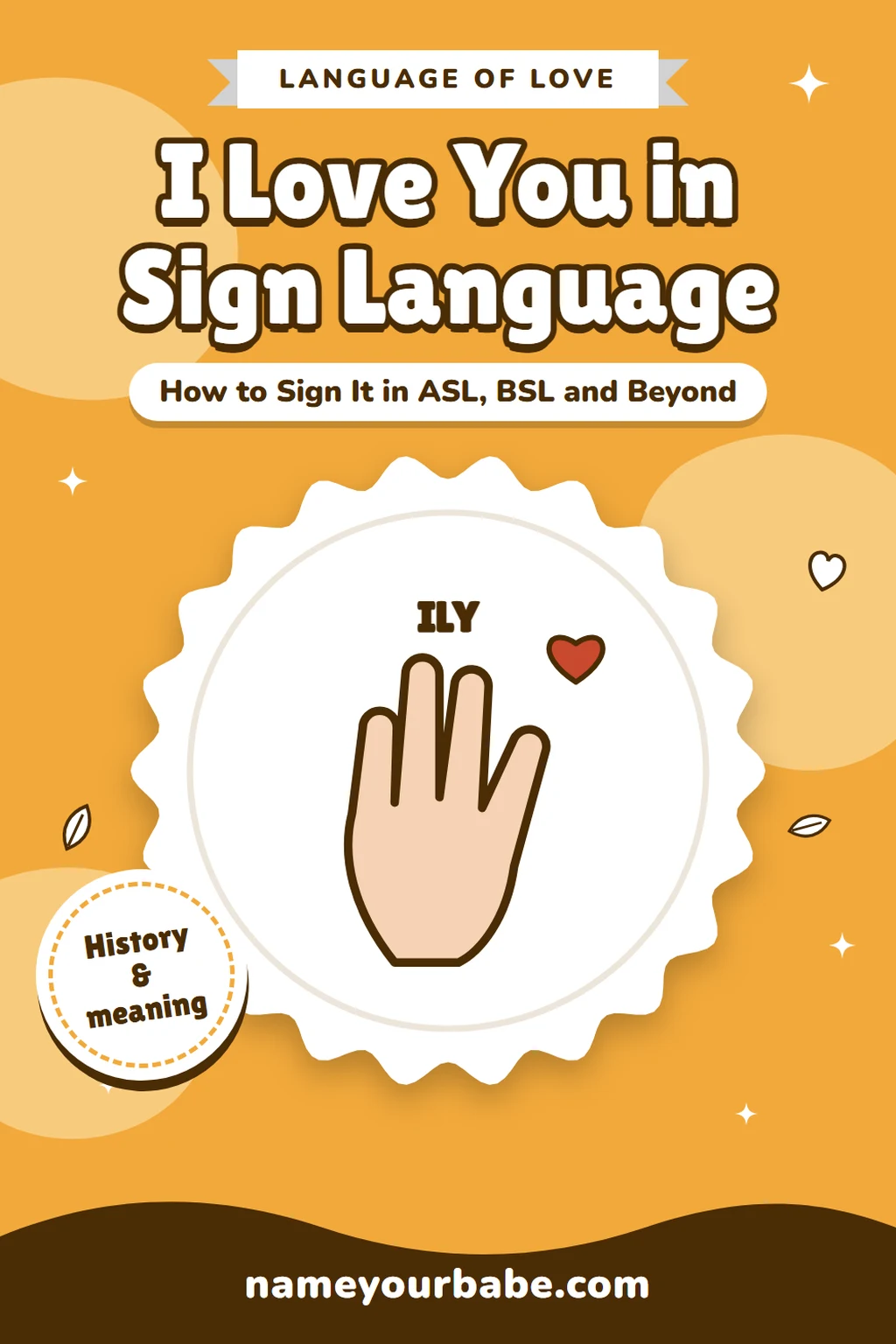
To say I love you in sign language the quickest way, use the American Sign Language (ASL) "ILY" sign: hold up one hand with your thumb, index finger and pinky finger extended, fold your middle and ring fingers down against your palm, and turn your palm to face the person you love. That one handshape blends the ASL letters I, L and Y. You can also sign the full sentence, I, LOVE, YOU, as three separate signs. Other sign languages, like British Sign Language (BSL), are different languages with their own signs, so the ILY handshape isn't universal.
This guide walks through both ASL versions step by step, explains how the ILY handshape is built from fingerspelling, clears up the most common mix-up (it's not the "rock on" sign), and looks at BSL, Auslan and why there's no single world sign language. We'll also cover a little Deaf-community etiquette, so you can use this beautiful sign with respect.
I love you in sign language: the ILY sign step by step
The ILY sign is the one most people picture. It's quick, it works from across a room, and it's meaningful whether you're saying goodbye at a door, cheering from the stands or waving from a car window. Here's how to make it.
- Choose your hand. Use your dominant hand, the one you write with. Either hand is understood, but your dominant hand will feel most natural.
- Make a loose fist. Start with your fingers curled into your palm.
- Raise your pinky. Straighten your little finger so it points up.
- Raise your index finger. Straighten your pointer finger so it points up too.
- Extend your thumb. Stick your thumb out to the side, away from your hand.
- Keep two fingers down. Your middle and ring fingers stay folded against your palm.
- Turn your palm out. Face your palm toward the person you're signing to, holding your hand up around shoulder height.
That's it. Three fingers up (thumb, index and pinky), two down (middle and ring), palm out. Many signers hold the sign still; some give it a small, gentle movement toward the person. A warm facial expression matters too, because in sign languages your face carries a lot of the meaning.
A quick self-check
| Finger | Position in ILY | Common mistake |
|---|---|---|
| Thumb | Extended out to the side | Tucking it in, which changes the sign |
| Index | Straight up | Bending it halfway |
| Middle | Folded down to the palm | Letting it creep up |
| Ring | Folded down to the palm | Letting it creep up with the middle finger |
| Pinky | Straight up | Leaving it curled |
| Palm | Facing the other person | Facing yourself |
If you only remember one thing, remember the thumb. The thumb is what separates ILY from a very different gesture, which we'll get to below.
How the ILY sign is built from fingerspelling
The ILY sign is clever. It isn't a random shape; it combines three letters of the ASL manual alphabet into one handshape. The National Institute on Deafness and Other Communication Disorders (NIDCD) explains that fingerspelling is part of ASL and is used to spell out English words, with each letter matching a distinct handshape. It's often used for names and for English words that don't have their own sign.
Here's how the three letters combine:
| ASL letter | Handshape | What it adds to ILY |
|---|---|---|
| I | Fist with the pinky finger straight up | The raised pinky |
| L | Thumb and index finger extended in an L shape, other fingers folded | The raised index finger and the extended thumb |
| Y | Thumb and pinky extended, other fingers folded | The extended thumb and pinky together |
| I + L + Y | Thumb, index and pinky extended; middle and ring folded | "I love you" in a single handshape |
Try it slowly. Make an I (pinky up). Now add the L (raise your index finger and thumb). Notice that your hand now also contains a Y (thumb and pinky). All three letters live in the same shape, which is why it reads as I-L-Y.
Why ASL's alphabet matters here
ASL uses a one-handed alphabet, so the letters can be blended on one hand. That detail matters when we look at other sign languages, because some of them use two-handed alphabets where this blend wouldn't work in the same way.
Where did the ILY sign come from?
You'll see confident origin stories for the ILY sign online, but its exact history isn't well documented in the authoritative sources we checked. What's clear is how it's built, from the ASL manual alphabet, and that it's thoroughly part of American signing culture. Rather than repeat an unverified story, we'll leave it at that.
Signing the full sentence: I, LOVE, YOU
The ILY handshape is a compact, affectionate sign, a bit like writing "luv u" or signing off a note with a heart. When you want to say it more fully, more deliberately, you can sign the sentence as three separate signs.
Step 1: I
Point to the center of your own chest with your index finger. In ASL, pointing is how you sign "I" or "me." You don't fingerspell the letter I for the pronoun.
Step 2: LOVE
Make both hands into fists. Cross your arms at the wrists and press your fists against your chest, over your heart, as if you're giving something a gentle hug.
Step 3: YOU
Point your index finger toward the person you're talking to.
Putting it together
Sign the three in a smooth sequence: point to yourself, cross your fists over your heart, then point to them. Keep eye contact and let your face show what you mean. A soft, sincere expression turns three signs into a real declaration.
ILY or the full sentence: which should you use?
| ILY handshape | I + LOVE + YOU | |
|---|---|---|
| Number of signs | One | Three |
| Feel | Casual, warm, quick | Deliberate, heartfelt |
| Best for | Goodbyes, waves, across a room, photos | Face-to-face moments, special occasions |
| Hands needed | One | Two (for LOVE) |
| Who it's for | Partners, family, friends, fans | Usually people you're close to |
Both are correct. Think of ILY as the hug-and-wave version and the full sentence as the look-them-in-the-eyes version.
The big mix-up: ILY versus the "rock on" gesture
This is the mistake that trips up the most people, and it all comes down to the thumb.
- ILY: thumb, index and pinky extended. Middle and ring fingers down.
- "Rock on" or "horns": index and pinky extended, with the thumb holding the middle and ring fingers down. No thumb sticking out.
At a glance they look alike, but the meaning is completely different. The "horns" gesture is a fan salute at rock concerts and has nothing to do with love. If you're signing ILY to someone, make sure your thumb is clearly out to the side.
Another lookalike: the Y handshape
If you fold your index finger down and keep only your thumb and pinky out, you've made the ASL letter Y. In everyday American gesture, that shape is often used as a "hang loose" wave. It's a perfectly friendly gesture, but it isn't ILY either. You need all three: thumb, index and pinky.
Common ILY mistakes at a glance
- Thumb tucked in (that's the "horns" gesture)
- Index finger folded down (that's the letter Y)
- Middle finger raised along with the others (an unclear, awkward shape)
- Palm facing yourself (it can look like you're reading your own hand)
- Rushing it with no facial expression (it can look flat or sarcastic)
ASL is a full language, not English on the hands
It's worth understanding a little about ASL itself, because it changes how you think about even a single sign. According to the NIDCD, ASL is a complete, natural language with the same linguistic properties as spoken languages, expressed through hand movements and facial expressions. It's the main language of many deaf and hard of hearing North Americans.
A few points from that page are especially useful for beginners:
- ASL isn't English. It has its own rules for pronunciation, word formation and word order. Its grammar is different from English grammar.
- No one person invented it. The NIDCD says ASL likely arose more than 200 years ago from a mix of local sign languages and French Sign Language (LSF). Today, ASL and LSF are distinct languages.
- It has accents and dialects. ASL varies by region, and age and gender can affect how people sign, just as with spoken languages.
The National Association of the Deaf's position statement on ASL describes it as the recognized sign language of the deaf community in the United States and a visual-spatial language whose structure differs from English. The NAD, founded in 1880 by deaf leaders, calls ASL a core value of the organization. The statement also quotes the deaf advocate George Veditz, who said in 1913, "As long as we have deaf people on earth, we will have signs."
Why does this matter for ILY? Because when you sign it, you're borrowing a word from a living language with its own history and community. That's a lovely thing to do, and it's worth doing with some care.
I love you in British Sign Language and other sign languages
Here's a surprise for many people: there is no universal sign language. The NIDCD notes that British Sign Language is a different language from ASL, and that Americans who know ASL may not understand BSL. That's true even though both countries speak English.
British Sign Language (BSL)
BSL is the language of the Deaf community in the United Kingdom, and it has official recognition. Section 1 of the British Sign Language Act 2022 states that BSL is recognized as a language of England, Wales and Scotland.
In BSL, "I love you" is usually expressed with separate signs for I, LOVE and YOU, rather than the American ILY handshape. Because BSL signs vary by region, the best way to learn the LOVE sign is to watch a fluent signer. The BSL SignBank, run by University College London's Deafness, Cognition and Language research group (DCAL), is a free online dictionary where you can search the English word "love" and see the related signs, along with fingerspelling and regional sign information.
One more key difference: BSL fingerspelling uses both hands. So the trick that makes ILY work in ASL, blending three one-handed letters into one shape, doesn't carry over to the BSL alphabet.
Auslan (Australian Sign Language)
Auslan is closely related to BSL. The Auslan Signbank's history page explains that Auslan developed from sign languages brought from Britain and Ireland in the 19th century, and that both Auslan and BSL grew out of early-1800s BSL. It notes that a deaf engraver, John Carmichael, brought BSL to Sydney in 1825, and that today Auslan fingerspelling is regularly done with the two-handed alphabet.
The same page adds something interesting: as interpreting services have grown, Auslan has borrowed signs from other sign languages, particularly from ASL. That kind of borrowing is one reason you may see familiar American signs in other countries, even though the languages themselves are different.
Comparing the three
| Language | Where it's used | Alphabet | Typical "I love you" |
|---|---|---|---|
| ASL | United States and parts of Canada | One-handed | ILY handshape, or I + LOVE + YOU |
| BSL | United Kingdom | Two-handed | Separate signs for I, LOVE, YOU; check BSL SignBank for regional LOVE signs |
| Auslan | Australia | Two-handed | Separate signs; learn from a fluent signer or Auslan Signbank |
Other sign languages
Many countries have their own national sign languages, each with its own vocabulary and grammar. If you want to say "I love you" to someone who signs a language other than ASL, the respectful and accurate approach is to ask them, or to look up their country's official sign language dictionary, rather than assume the American ILY will mean the same thing. If you're interested in how spoken languages express love differently, our guide to pet names from around the world is a good companion read.
A short history of signing in the English-speaking world
The fact that Americans, Britons and Australians all speak English but sign differently surprises a lot of people. The history explains it. Sign languages grow up in Deaf communities, especially around schools for deaf children, and they follow their own paths rather than the path of the spoken language around them.
| When | What happened | Source |
|---|---|---|
| More than 200 years ago | ASL likely begins to form from local sign languages mixed with French Sign Language | NIDCD |
| Early 1800s | BSL, as used in large residential deaf schools, gives rise to both modern BSL and Auslan | Auslan Signbank |
| 1825 | John Carmichael, a deaf engraver, brings BSL to Sydney | Auslan Signbank |
| 1860 | Thomas Pattison starts a school for deaf children in Sydney; a Melbourne school is founded around the same time | Auslan Signbank |
| 1875 | Irish nuns found the first school for Catholic deaf children in Australia, bringing Irish Sign Language and its one-handed alphabet | Auslan Signbank |
| 1880 | Deaf leaders found the National Association of the Deaf in the US | NAD |
| 1913 | George Veditz: "As long as we have deaf people on earth, we will have signs" | NAD |
| 2022 | The British Sign Language Act recognizes BSL as a language of England, Wales and Scotland | legislation.gov.uk |
Two things stand out. First, ASL's roots are partly French, not British, which is a big reason ASL and BSL are so different. Second, sign languages travel with people and schools. Auslan's story, with British signs arriving in Sydney and Irish signs arriving with nuns, shows how a sign language can carry traces of several others. The Auslan Signbank notes that the Irish one-handed alphabet and Irish-based signs were kept alive in Catholic schools into the mid-20th century, even though British-based signing remained the main influence.
So when someone asks why the ILY sign isn't the same everywhere, the short answer is: because ASL, BSL and Auslan are different languages with different histories, even though their hearing neighbors all speak English.
The love-you gesture emoji
The ILY handshape has its own emoji. In the Unicode Consortium's official emoji test data file, it's listed as "love-you gesture," code point U+1F91F, introduced in Emoji version 5.0. Unicode files it in the "hand-fingers-partial" subgroup, alongside other hand gestures.
A couple of things to know about it:
- It's the real ILY shape. The design shows the thumb, index and pinky extended, so it isn't the "horns" gesture. Unicode lists that one separately, under the name "sign of the horns."
- It looks a little different on every platform. Apple, Google, Samsung and others each draw their own version, so the angle and skin tone default can vary.
- It supports skin tones. Like most hand emoji, it comes in several skin tone versions.
It's a sweet choice to end a text with, especially for someone who signs or is learning. For other ideas for your messages, see our guide to texting nicknames.
Deaf culture and respectful signing
Using a sign from ASL is a small act of connection with the Deaf community. A few simple guidelines will help you do it well.
Use respectful words
The National Association of the Deaf's guidelines for media portrayal of the deaf community recommend the terms "deaf," "hard of hearing," "deaf or hard of hearing," or "deaf and hard of hearing." The NAD calls terms like "deaf-mute," "hearing impaired" and "hearing disabled" outdated and inaccurate, saying they make assumptions about a person's abilities. It also advises against phrases like "suffering from" or "victim of" deafness.
You'll also often see "Deaf" with a capital D, which is commonly used to refer to people who identify with Deaf culture and use a sign language, as opposed to lowercase "deaf," which describes hearing status. Usage varies, so follow the lead of the people and organizations you're talking with.
Learn from Deaf signers
Videos, apps and articles like this one are a fine start, but the best way to learn a sign language is from fluent, ideally Deaf, teachers. The NAD's position statement encourages immersion and interaction with fluent members of the deaf community, especially for families of deaf children. Many community colleges and Deaf organizations offer classes.
Respect the meaning
The ILY sign is used warmly and widely, including at sports events and in photos. That's part of its charm. Just avoid using it as a joke or a costume prop, and remember it's a real word in a real language.
If your partner is deaf or hard of hearing
If you're dating or married to someone who signs, learning "I love you" is a lovely first step, and your partner will likely notice the effort. A few thoughts to keep in mind:
- Let them lead. Ask which sign language they use and how they like to say "I love you." They may have a personal or family way of signing it.
- Keep going. One sign is a start, not a finish. Learning more of their language, little by little, says more than any single gesture.
- Take a class together, or separately. A course with a Deaf teacher will teach you not just vocabulary but grammar, culture and conversation habits you won't pick up from videos.
- Don't make them your only teacher. It's lovely to learn from your partner, but constantly asking them to teach can be tiring. Mix in classes and community events.
- Every person is different. Some deaf and hard of hearing people sign, some use spoken language, some use both. Follow your partner's preferences rather than assumptions.
Everyday courtesy tips
- Get someone's attention with a small wave in their line of sight, or a light tap on the shoulder, rather than shouting.
- Keep eye contact while signing. Looking away mid-conversation is a bit like walking out of the room while someone's talking.
- Don't cover your mouth if the person reads lips as well as signs.
- If you're not sure what someone prefers, ask. People are usually glad you did.
Where to look up signs you can trust
Online, it's easy to find a video of someone signing "I love you" with the wrong handshape, or a list of "signs" that are really made-up gestures. When you want to check a sign, go to a dictionary built by researchers and Deaf signers. Here are three good ones.
| Dictionary | Language | Who's behind it | Good for |
|---|---|---|---|
| ASL Signbank | American Sign Language | Researchers at Gallaudet University and the University of Connecticut | Checking how a sign is glossed by linguists |
| BSL SignBank | British Sign Language | University College London's DCAL research group | Searching by English word, regional signs, fingerspelling |
| Auslan Signbank | Australian Sign Language | An online Auslan language resource | Dictionary videos, history, community information |
The ASL Signbank describes itself as a collection of ASL signs linked to "ID glosses," which are standard labels linguists use to identify each sign, and it's maintained by researchers at the University of Connecticut and Gallaudet University in Washington, DC. It's designed mainly for researchers annotating ASL videos, so it can feel technical, but it's a trustworthy reference. Its search page suggests using the "translation equivalents" box if you don't know a sign's gloss, which is the easiest way in for beginners.
Tips for learning from videos
- Watch the whole body. Note where the hands are, how they move, and what the face is doing, not just the fingers.
- Mirror, don't copy. If the signer is facing you and using their right hand, you'll use your right hand too, which appears on the opposite side of your screen.
- Slow it down. Most video players let you reduce the speed. Use it.
- Check two sources. If a sign looks different in two places, it may be a regional variant, or one of them may be wrong.
Signing I love you to different people
"I love you" isn't only for romantic partners, and the ILY sign is used across all kinds of relationships. Here's how the two versions tend to fit different situations, in general terms.
Your partner
Both versions work. ILY is perfect for everyday goodbyes, and the full I, LOVE, YOU sentence is lovely for quieter, more serious moments, like an anniversary or a proposal. If your partner is Deaf or hard of hearing and signs, ask them how they like to say it. Every couple develops their own habits.
Children
Many families use the ILY sign with children because it's simple, visual and easy for small hands to copy. It's a nice way to say goodbye at a school drop-off without embarrassing an older child with a hug in front of friends.
Grandparents and older relatives
For relatives who are losing some hearing, a visual "I love you" can be a warm addition to spoken words, especially across a noisy room. It's not a replacement for good communication, but it's a sweet extra.
Friends and crowds
You'll sometimes see the ILY sign held up at concerts, games and graduations as a general "love you all." In that setting, it's friendly and broad rather than romantic.
Why your face matters as much as your hands
The NIDCD describes ASL as a language expressed through both hand movements and facial expressions. That second part is easy for beginners to forget. In spoken English, you can say "I love you" flatly, warmly, teasingly or sadly, and your tone of voice does the work. In ASL, much of that tone lives on your face.
- Warm and sincere: soft eyes, a gentle smile, steady eye contact.
- Playful: a bigger grin, maybe a little bounce in the hand.
- Deeply heartfelt: a slower sign, held a moment longer, with a calm, open expression.
A blank face with a perfect handshape can look oddly flat. A warm face with a slightly wobbly handshape will still come across as loving. When you're starting out, don't be shy about letting your feelings show.
Romantic signing: beyond "I love you"
Once you can sign "I love you," you may want to build on it. Here are some gentle ways to do that without getting ahead of what you can sign accurately.
Fingerspell their name
Since fingerspelling is how ASL represents names, learning to fingerspell your partner's name is a lovely gesture. Practice the letters slowly, then smoothly. In Deaf communities, people may also receive a "name sign," a personal sign that stands for their name. Name signs are traditionally given by Deaf community members, not invented by hearing people for themselves, so if your partner has one, ask them to teach it to you.
Pair ILY with a pet name
Many couples have a spoken pet name they love. You can sign ILY and then fingerspell a short pet name, or just mouth it with a smile. Our overview of terms of endearment has plenty of ideas to choose from.
Make it a ritual
Some couples and families sign ILY every time they part, through a window, across a parking lot or from the school gate. It becomes a tiny daily ritual. Small, repeated gestures like that are one of the nicest ways to make your partner feel special.
Try it yourself: a five-minute practice plan
Here's a quick routine to make the signs feel natural.
- Minute 1: Letters. Make the ASL I, then L, then Y, slowly, five times each.
- Minute 2: Blend. Go from I to ILY by adding the index finger and thumb. Repeat ten times.
- Minute 3: Check the thumb. Alternate between ILY (thumb out) and the "horns" gesture (thumb in) so you can feel the difference.
- Minute 4: The full sentence. Point to your chest, cross your fists over your heart, point outward. Repeat five times, smoothly.
- Minute 5: Add your face. Do both versions in a mirror with a warm expression. Notice how much more meaning your face adds.
Teaching ILY to a child
Small children often love learning ILY, and it's a sweet sign to share. Here's an easy way to teach it.
- Start with the pinky. Ask them to make a fist and pop up their "little finger." That's the letter I.
- Add the pointer. Now pop up the pointer finger too.
- Add the thumb. Finally, stick the thumb out to the side, "like a hitchhiker."
- Check the middle fingers. Gently fold the middle and ring fingers down if they pop up. Little hands find this part tricky, so it's fine if it's not perfect at first.
- Turn it around. Show them how to face the palm toward the person they love.
Making it a goodbye habit at the door or the school gate helps it stick.
An illustrative example
Here's a made-up scenario, purely to illustrate. Jess is dropping her partner off at the airport. There's no time to talk at the curb, so as the car pulls away she raises her hand, palm out: thumb, index and pinky up. Her partner, watching from the doorway, signs it back. No words needed. That's what ILY is perfect for.
If you're planning a special moment, like a Valentine's surprise, signing the full I, LOVE, YOU face to face can be unforgettable. Our Valentine's Day ideas pair well with it.
Signing your love, the right way
To say I love you in sign language, the simplest choice is the ASL ILY sign: thumb, index and pinky extended, middle and ring fingers folded, palm facing your loved one. It blends the ASL letters I, L and Y into one warm handshape. For a fuller statement, sign I (point to yourself), LOVE (fists crossed over your heart) and YOU (point to them). Remember the thumb, so you don't accidentally make the "horns" gesture. And remember that ASL is one language among many: BSL, Auslan and other sign languages have their own signs, so learn from fluent signers and use the language with respect.
If you'd like a sweet name to go with your sign, try the free nickname generator on our homepage. You pick who it's for (boyfriend, girlfriend, husband, wife, fiancé or fiancée, crush or partner) and a vibe such as cute and sweet, romantic, funny, flirty, unique or classic. Each suggestion comes with a short note on why it works, and you can save favorites to a shortlist or blend your names with the Couple Name Mixer.
ILY, "Rock On" and the Letters I, L and Y Compared
These handshapes look alike but mean different things. This table shows which fingers are up and what the thumb does in each one.
| Handshape | Fingers up | Thumb |
|---|---|---|
| ILY (I love you) | Index and pinky; middle and ring fingers stay down | Extended out to the side |
| "Rock on" or "horns" | Index and pinky | Holds the middle and ring fingers down, so no thumb sticks out |
| Letter Y | Pinky only, with the index finger folded down | Extended |
| Letter L | Index finger, with the other fingers folded | Extended, making an L shape |
| Letter I | Pinky only, in a fist | Part of the fist |
Frequently Asked Questions
How do you sign I love you in ASL?
The quickest way is the ILY sign. Hold up your dominant hand with your thumb, index finger and pinky extended, and fold your middle and ring fingers down against your palm. Turn your palm toward the person you're signing to. For a fuller version, sign three separate signs: point to your own chest for I, cross your fists at the wrists over your heart for LOVE, then point to the other person for YOU. Both are correct, and a warm facial expression helps.
What do the three fingers in the I love you sign mean?
The ILY handshape combines three letters of the American Sign Language manual alphabet. The raised pinky is the letter I. The raised index finger and extended thumb form the letter L. The extended thumb and pinky together form the letter Y. Because ASL uses a one-handed alphabet, all three letters can be blended into a single shape, which is why the sign reads as I-L-Y, short for I love you.
Is the I love you sign the same as rock on?
No, and the difference is the thumb. In the ILY sign, your thumb sticks out to the side along with your index and pinky fingers. In the rock on or horns gesture, only the index and pinky are raised, and the thumb holds the middle and ring fingers down. The Unicode Consortium even lists them as separate emoji: love-you gesture and sign of the horns. If you mean I love you, make sure your thumb is clearly extended.
Is the I love you sign the same in British Sign Language?
Not usually. British Sign Language is a different language from American Sign Language, and the US National Institute on Deafness and Other Communication Disorders notes that people who know ASL may not understand BSL. BSL also uses a two-handed alphabet, so the ASL trick of blending I, L and Y into one handshape doesn't come from BSL. In BSL, I love you is usually signed with separate signs. The free BSL SignBank from University College London shows signs for love.
Is there a universal sign for I love you?
No. There is no universal sign language, and each country's sign language has its own vocabulary and grammar. The ILY handshape is an American Sign Language sign, and while some people in other countries may recognize it, it isn't part of every sign language. If you want to say I love you to someone who uses a different sign language, the best approach is to ask them or check their national sign language dictionary, such as BSL SignBank or Auslan Signbank.
Is there an emoji for the I love you sign?
Yes. The Unicode Consortium lists it as the love-you gesture, code point U+1F91F, introduced in Emoji version 5.0. It shows a hand with the thumb, index finger and pinky extended, matching the ASL ILY handshape. It sits in Unicode's hand-fingers-partial group with other hand gestures and comes in several skin tones. Each platform draws it a little differently, so it may look slightly different on Apple, Google or Samsung devices, but the meaning is the same.
Which hand should I use for the ILY sign?
Use your dominant hand, the one you write with. In American Sign Language, signers generally use their dominant hand for one-handed signs, and either hand will be understood for ILY. What matters more is the handshape and orientation: thumb, index and pinky extended, middle and ring fingers folded, and your palm facing the person you're signing to. If you're left-handed, sign it with your left hand. Consistency feels more natural than switching hands.
Is it okay for hearing people to use the ILY sign?
Yes, it's widely used by hearing people, including families, couples and sports fans, and many Deaf people appreciate hearing people learning signs. The key is respect. ASL is a full language used by the deaf community, so avoid using the sign as a joke or a costume prop. If you'd like to go further, learn from fluent, ideally Deaf, teachers. The National Association of the Deaf encourages immersion and interaction with fluent signers as the best way to learn.
What are respectful terms to use when talking about deaf people?
The National Association of the Deaf recommends the terms deaf, hard of hearing, deaf or hard of hearing, and deaf and hard of hearing. It describes terms like deaf-mute, hearing impaired and hearing disabled as outdated and inaccurate, because they make assumptions about a person's abilities. It also advises against phrases like suffering from or victim of. Many people use Deaf with a capital D for those who identify with Deaf culture, so follow the lead of the person you're talking with.
Sources
We checked every source below while writing this guide. Last reviewed October 30, 2026, by Joan Ramos.
- American Sign Language (National Institute on Deafness and Other Communication Disorders (NIH))
- Position Statement on American Sign Language (National Association of the Deaf)
- Guidelines for Media Portrayal of the Deaf Community (National Association of the Deaf)
- British Sign Language Act 2022, Section 1 (legislation.gov.uk (The National Archives))
- BSL SignBank (University College London, Deafness, Cognition and Language (DCAL))
- ASL Signbank (University of Connecticut and Gallaudet University)
- History of Auslan (Auslan Signbank)
- Emoji test data (emoji-test.txt) (Unicode Consortium)