Love Idioms and Their Origins: Head Over Heels, Tie the Knot and More
Love idioms are phrases like "head over heels," "tie the knot," "puppy love" and "wear your heart on your sleeve" whose meaning isn't the sum of their words. Nobody actually flips upside down when they fall in love, and nobody ties a real knot at most weddings. Many of these phrases are hundreds of years old, and several have surprising backstories. "Head over heels," for instance, started out as "heels over head," which made much more sense.
This guide explains about 40 common English love idioms: what each one means, how to use it, and where it came from when the history is known. Dates come from Dictionary.com's idiom and word-origin notes, and the oldest literary phrases are quoted from the texts themselves, including Shakespeare's plays via the Folger Shakespeare Library. Where an origin story is uncertain or just a popular guess, we say so.
Love idioms at a glance
Here's a quick-reference list of the love idioms covered in this guide, grouped by the stage of a relationship they usually describe.
| Idiom | Meaning | Stage |
|---|---|---|
| have a crush on | feel a strong, often short-lived attraction | Early feelings |
| puppy love / calf love | young, short-lived infatuation | Early feelings |
| love at first sight | falling for someone the moment you see them | Early feelings |
| fall for someone | start to love someone | Falling in love |
| head over heels | completely in love | Falling in love |
| swept off one's feet | suddenly and overwhelmingly charmed | Falling in love |
| smitten | strongly attracted, captivated | Falling in love |
| starry-eyed | dreamily, idealistically in love | Falling in love |
| lovesick | so in love it's hard to think of anything else | Falling in love |
| only have eyes for | be interested in one person only | Together |
| lovey-dovey | openly, sweetly affectionate | Together |
| lovebirds | a couple who are very affectionate | Together |
| apple of my eye | a person you cherish most | Together |
| wear your heart on your sleeve | show your feelings openly | Together |
| an item | a recognized couple | Together |
| go steady | date one person exclusively | Together |
| pop the question | propose marriage | Commitment |
| tie the knot | get married | Commitment |
| get hitched | get married (informal) | Commitment |
| walk down the aisle | get married | Commitment |
| better half | one's spouse or partner | Commitment |
| match made in heaven | a perfect pairing | Commitment |
| made for each other | perfectly suited | Commitment |
| soul mate | a person you feel deeply connected to | Commitment |
| carry a torch for | keep loving someone who doesn't love you back | Heartache |
| old flame | a former romantic partner | Heartache |
| on the rocks | in serious trouble | Heartache |
| plenty of fish in the sea | there are many other people to love | Heartache |
| the course of true love never did run smooth | real love meets obstacles | Heartache |
| kiss and make up | make peace after a quarrel | Heartache |
An idiom, by the way, is a fixed phrase whose meaning you can't work out just from its words. "Tie the knot" is an idiom. "Get married" isn't. Idioms are a big part of how English speakers talk about love, so they're worth knowing whether you're learning English or just curious.
Head over heels: the idiom that flipped
"Head over heels" means completely, often as in "head over heels in love." According to Dictionary.com's entry for head over heels, the phrase first appeared in the 1300s as heels over head, describing someone literally upside down, like a person tumbling or doing a somersault. It took its current wording in the 1700s and picked up its figurative meaning in the 1800s.
Think about that for a second. "Heels over head" makes perfect sense: your heels end up above your head when you flip. "Head over heels" is just how we normally stand. Over time, though, the flipped version won out, and it came to mean being turned upside down by love. It's a great example of how idioms can drift away from logic and still be understood by everyone.
How to use it
- "They fell head over heels for each other on their first trip together."
- "He's head over heels about his new hobby." (It doesn't have to be about love.)
Early feelings: crushes, puppy love and love at first sight
Have a crush on
To have a crush on someone is to feel a strong but usually short-lived attraction to them. In this sense, a crush is an intense infatuation that usually doesn't last. The word "crush" itself is very old, but the specific romantic sense is much newer. Its exact origin is debated, so we won't guess.
Puppy love and calf love
Puppy love is a young person's short-lived crush. Dictionary.com's entry for puppy love describes it as adolescent love or infatuation that isn't expected to last, notes that British English also calls it calf love, and says it was first recorded in the first half of the 1800s. The comparison to puppies and calves points to youth and eagerness. It can sound dismissive, so be careful using it about someone else's feelings.
Love at first sight
This one has a famous literary pedigree. In Christopher Marlowe's long poem Hero and Leander, the narrator asks:
"Where both deliberate, the love is slight:
Who ever loved, that loved not at first sight?"
Shakespeare quoted that second line in As You Like It. In Act 3, scene 5, the shepherdess Phoebe, newly smitten herself, says: "Dead shepherd, now I find thy saw of might: / 'Who ever loved that loved not at first sight?'" (A "saw" is a saying.) You can read the scene in the Folger Shakespeare Library's text of As You Like It. Many readers take the "dead shepherd" as Shakespeare's nod to Marlowe, the poet he's quoting.
Starry-eyed, smitten and lovesick
- Starry-eyed means dreamily or idealistically in love, as if your eyes are full of stars.
- Smitten is the old past participle of "smite," to strike. If you're smitten, you've been struck by love, a lot like Cupid's arrow.
- Lovesick describes someone so in love that they're distracted, moody or unable to eat or sleep. It treats love almost like an illness, an idea that goes back to ancient and medieval medicine.
Falling in love: fall for, swept off your feet and more
Fall for someone
To fall for someone is to start loving them. It's related to "fall in love," which pictures love as something you drop into, not something you calmly walk into. "Fall for" can also mean being fooled ("She fell for the prank"), so context matters.
Swept off one's feet
If someone sweeps you off your feet, they charm you suddenly and completely. The image is of being lifted by a wave or a strong wind, unable to stand your ground. It's often used for grand romantic gestures.
Only have eyes for
To only have eyes for someone is to be interested in no one else. It's a sweet idiom for faithfulness and attention, and it's often used in song lyrics.
Love is blind
"Love is blind" means that people in love don't see each other's faults. Shakespeare plays with the idea often. In A Midsummer Night's Dream, Helena says, "Love looks not with the eyes but with the mind; / And therefore is winged Cupid painted blind," according to the Folger text of Act 1, scene 1. Her point is a little different from the modern idiom: love doesn't judge by appearances, which is why artists painted Cupid blindfolded.
Showing affection: lovey-dovey, lovebirds and the apple of my eye
Lovey-dovey
"Lovey-dovey" means openly and sweetly affectionate, sometimes a bit too much for onlookers. Dictionary.com's entry for lovey-dovey dates it to about 1810 to 1820, when it was a fond term of address, and explains that it combines "love," "dove" and the friendly "-ey" ending. Doves have long been symbols of gentle love, so the rhyme is fitting. The American sense is simply "amorously affectionate," while the British sense leans toward a showy display.
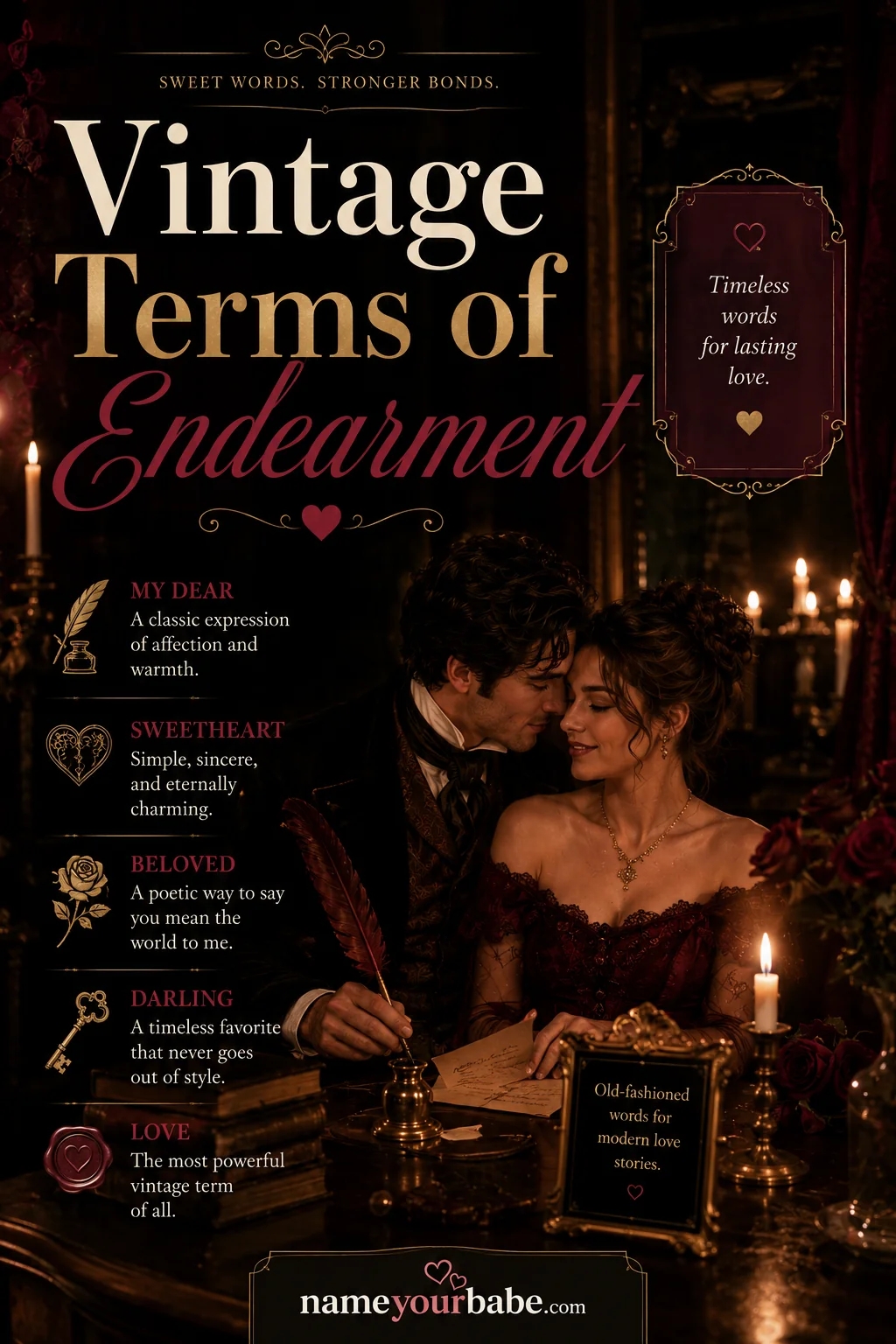
The fact that "lovey-dovey" began as something you called a person, like "sweetie," connects it to the long English habit of rhyming pet names. If you enjoy old-fashioned sweet talk, our guide to vintage terms of endearment is full of them.
Lovebirds
Calling a couple "lovebirds" means they're very affectionate with each other. The real lovebirds are small parrots known for sitting close together in pairs. It's a gentle, often teasing idiom: "Okay, lovebirds, dinner's ready."
The apple of my eye
The apple of your eye is the person you cherish most. This idiom comes from the King James Bible. In Deuteronomy 32:10, God protects his people: "he kept him as the apple of his eye," as shown in the King James text at Blue Letter Bible. In older English, the "apple" of the eye was the pupil, the round center you protect instinctively. So the person who is "the apple of your eye" is someone you'd guard as carefully as your own sight. Today it's used for partners, children and grandchildren alike.
Wear your heart on your sleeve
To wear your heart on your sleeve is to show your feelings openly. Its most famous early use is in Shakespeare's Othello, and it isn't romantic at all. The scheming Iago says he'll never reveal his true feelings, because if he did, "I will wear my heart upon my sleeve / For daws to peck at. I am not what I am." You can read the line in the Folger text of Othello, Act 1, scene 1. (Daws are jackdaws, small crows.) Iago's point is that showing your heart makes you vulnerable. Today the phrase is usually neutral or even admiring: someone who wears their heart on their sleeve is honest about how they feel.
Sweet on someone
To be sweet on someone means to be fond of them or attracted to them. It's a gentle, slightly old-fashioned phrase that you might hear from a grandparent: "I think he's sweet on her."
Proposals and weddings: pop the question and tie the knot
Pop the question
To pop the question is to propose marriage. According to Dictionary.com's entry for pop the question, the idiom dates to the early 1700s. "Pop" here suggests something sudden and quick, like a cork popping. Since there's only one "question" anyone means when they say it, the idiom never needs to spell it out.
Tie the knot
To tie the knot means to get married, or, for an officiant, to perform the marriage ceremony. Dictionary.com's entry for tie the knot dates the phrase to the early 1700s. Knots have long been an image for a lasting bond, which is why the phrase feels so natural. You'll see various specific "origin stories" online, such as handfasting ceremonies where a couple's hands are tied together. Those customs are real in some traditions, but there's no clear evidence that any one of them is the source of the idiom, so treat those stories as possible influences rather than proven origins.
Get hitched and walk down the aisle
- Get hitched is an informal way to say "get married." "Hitch" means to fasten or harness, as when you hitch a horse to a wagon, so the picture is of two people being joined to pull through life together. It has a casual, American feel.
- Walk down the aisle means to get married, from the walk along the center aisle of a church or venue during a ceremony.
Better half
Your better half is your spouse or partner. It's affectionate and a little humorous, with a modest twist: you're saying your partner is the better of the two of you.
Perfect pairs: soul mates and matches made in heaven
- Match made in heaven: a perfect pairing, as if arranged by a higher power. It's often used humorously for non-romantic pairs too, like "peanut butter and jelly are a match made in heaven."
- Made for each other: perfectly suited, as if designed to fit together.
- Soul mate: a person you feel deeply connected to. The connection is often romantic, though people also use it for close friends. It's spelled both as two words and as one, "soulmate."
- Two peas in a pod: two people who are very alike. It isn't only for couples, but it's often used for them.
- An item: a recognized couple, as in "Are they an item now?"
- Go steady: date one person exclusively. It's an older American phrase with a nostalgic, high-school feel.
Many couples turn phrases like these into shared nicknames. If that sounds like you, our guide to matching nicknames for couples has ideas built on pairs.
Heartache idioms: carrying a torch and old flames
Love idioms aren't all sunshine. English has a rich set of phrases for the hard parts too.
Carry a torch for someone
To carry a torch for someone is to keep loving them even though they don't love you back, or after the relationship has ended. The image is of keeping a flame burning in the dark. It's related to "torch song," a sad song about lost or unrequited love. ("Unrequited" means not returned.)
Old flame
An old flame is a former romantic partner. Fire is one of the oldest metaphors for love in English: love "sparks," "burns," "kindles" and "goes out." An old flame is a fire from the past. It's usually said with affection, not bitterness.
On the rocks
A relationship that's "on the rocks" is in serious trouble. The image is of a ship that's run aground on rocks and is breaking apart. (The same phrase also describes a drink served over ice, which can lead to some confusing sentences.)
Plenty of fish in the sea
"There are plenty of (other) fish in the sea" is something friends say after a breakup. It means there are many other people you could love. It's meant kindly, though it isn't always comforting in the moment.
The course of true love never did run smooth
This line comes straight from Shakespeare. In A Midsummer Night's Dream, Lysander tells Hermia, "Ay me! For aught that I could ever read, / Could ever hear by tale or history, / The course of true love never did run smooth," according to the Folger text of Act 1, scene 1. The couple are facing a disapproving father, and Lysander is saying that every great love story has obstacles. People still quote it, often shortened to "the course of true love never runs smooth."
Kiss and make up
To kiss and make up is to make peace after an argument. It can be literal for couples, but it's often used for friends, coworkers or even companies that have settled a dispute.
More love idioms worth knowing
English has dozens more phrases about love, many built around the heart. Their exact origins are mostly undocumented, so here we focus on meaning and use.
Heart idioms
- Lose your heart to someone: fall in love with them. The idea is that your heart now belongs to someone else. "She lost her heart to a fellow volunteer at the animal shelter."
- Steal someone's heart: make someone fall in love with you, often without trying. Babies and puppies are said to steal hearts too.
- Your heart skips a beat: you feel a sudden rush of excitement or nerves, often when you see someone you love. It describes the fluttery feeling, not a medical event.
- Pour your heart out: tell someone all your feelings, usually at length and with emotion.
- From the bottom of my heart: with complete sincerity. It's common in thank-you notes and vows.
- Set your heart on something: want something very much. "He'd set his heart on proposing at the lake where they met."
- Have a soft spot for: feel special affection for someone, often despite their faults.
Feelings and situations
- Butterflies in your stomach: a nervous, fluttery feeling, often before a date or when meeting someone you like.
- Head in the clouds: dreamy and distracted. New love can put anyone's head in the clouds.
- Love-hate relationship: a mix of strong affection and strong frustration. It's often used jokingly about things like a favorite but difficult hobby.
- The love of my life: the person you love most, usually a long-term partner.
- Love you to the moon and back: love you more than any distance can measure. It's especially popular between parents and children.
- Blind date: a date between two people who haven't met, usually set up by friends.
- Third wheel: a person who feels left out while spending time with a couple, like an extra wheel that isn't needed.
- Play hard to get: pretend not to be interested, to make someone try harder.
- Cupboard love: a mainly British phrase for affection shown in order to get something, like a cat that's sweetest at dinnertime.
- Love match: a marriage made for love rather than for money or family advantage. It sounds old-fashioned because, for centuries, many marriages were arranged for practical reasons.
Heart idioms make lovely raw material for cards and notes. "You stole my heart," "you make my heart skip a beat" and "from the bottom of my heart" are simple, sincere lines that never go out of style.
A timeline of love idioms with known dates
Many idioms are hard to date precisely, because people used them in speech long before anyone wrote them down. These are the ones where we have a published date or a dated text.
| When | Idiom | What happened | Source |
|---|---|---|---|
| 1300s | heels over head | First appears, describing someone literally upside down | Dictionary.com |
| Early 1700s | pop the question | Idiom for proposing marriage appears | Dictionary.com |
| Early 1700s | tie the knot | Idiom for getting married appears | Dictionary.com |
| 1700s | head over heels | Current word order takes hold | Dictionary.com |
| About 1810 to 1820 | lovey-dovey | First used as a fond term of address | Dictionary.com |
| First half of the 1800s | puppy love | First recorded | Dictionary.com |
| 1800s | head over heels | Takes on the figurative meaning "completely" | Dictionary.com |
The Shakespeare and Marlowe lines are older than most of these dates, and the "apple of his eye" phrase in the King James Bible is older still. Those are quoted from the texts above rather than given dates here.
The hidden pictures inside love idioms
Look at enough love idioms and you'll notice they keep reusing the same few pictures. Grouping them this way makes them easier to remember, and it shows how English speakers imagine love.
| Picture | What it suggests about love | Idioms that use it |
|---|---|---|
| Falling and tumbling | Love happens to you; you lose your balance | fall for, fall in love, head over heels, swept off your feet |
| Fire and light | Love is warm, bright and can burn out | old flame, carry a torch, spark, starry-eyed |
| Being struck | Love arrives suddenly, from outside | smitten, love at first sight |
| Illness | Love can overwhelm body and mind | lovesick, butterflies in your stomach |
| Sweetness | Love is pleasant and nourishing | sweet on, sweetheart |
| Birds | Love is gentle and paired | lovebirds, lovey-dovey |
| Binding and joining | Love is a lasting tie | tie the knot, get hitched, made for each other |
| Sight | Love changes how you see | apple of my eye, only have eyes for, love is blind |
Notice how many of these pictures make love something that happens to you. You fall, you're struck, you're swept away, you're smitten. Only later, in the commitment idioms, do people actively do something: pop the question, tie the knot, walk down the aisle. In a small way, the idioms tell the story of a relationship, from surprise to choice.
This pattern also helps when you meet a love idiom you've never heard before. Ask which picture it's using. If it's about fire, it's probably about passion or a past love. If it's about falling or flying, it's probably about the early, dizzy stage. If it's about tying or joining, it's probably about commitment. That simple question will get you close to the meaning most of the time, even before you look it up.
Common mix-ups with love idioms
- "Heels over head" isn't a mistake. It's the older, original form. "Head over heels" is the newer version that won.
- "Wear your heart on your sleeve" didn't start as a compliment. In Othello, Iago uses it to explain why he hides his feelings.
- "The apple of my eye" has nothing to do with fruit. The "apple" is the pupil of the eye.
- "Tie the knot" doesn't have one proven origin. Stories about handfasting or knotted cords are possible influences, not documented sources.
- "Puppy love" can sound dismissive. It implies the feelings won't last, so it's best used about yourself, looking back.
- "On the rocks" has two meanings. A relationship on the rocks is in trouble. A drink on the rocks just has ice.
- "Fall for" can mean being tricked. "He fell for her" and "he fell for it" are very different sentences.
How to use love idioms naturally
Idioms add color to speech and writing, but they work best in moderation. Here are a few tips.
- Match the tone. "Tie the knot" and "get hitched" are casual. In a formal wedding toast, you might say "marry" instead, or use the idiom once for warmth.
- Don't stack them. "We fell head over heels, tied the knot and are two peas in a pod" sounds like a greeting card. One idiom per sentence is plenty.
- Know your audience. English learners may not know idioms like "carry a torch." If you're writing for a mixed audience, a quick explanation helps.
- Use the literary ones with care. Quoting "the course of true love never did run smooth" is lovely in a card or a toast, especially if you know it's from Shakespeare.
A worked example: a toast with idioms
Here's an illustrative wedding toast that uses idioms well. The couple's names are made up.
"When Maya met Leo, it wasn't love at first sight. It was more like love at the third coffee. But once she fell for him, she fell head over heels. Leo has always worn his heart on his sleeve, so we all knew how he felt long before he popped the question. Shakespeare said the course of true love never did run smooth, and these two have had their bumps. But watching them today, I can tell you they're a match made in heaven. Please raise your glasses to Maya and Leo."
Notice that each idiom does a job: it moves the story forward or adds a feeling. That's the difference between using idioms and just collecting them.
Try it yourself: match the idiom
Test yourself. Match each situation with the best idiom from this guide. Answers are below.
- Your friend still saves every letter from a partner who moved on years ago.
- Your grandparents still hold hands and call each other "sweetheart."
- Your cousin just got engaged on a mountaintop.
- Your coworker posts about her partner every single day.
- Two friends who argued all week are laughing together again.
- Your little brother can't stop talking about a classmate he met last week.
Answers: (1) carrying a torch. (2) lovebirds, or lovey-dovey. (3) her partner popped the question. (4) she wears her heart on her sleeve. (5) they kissed and made up. (6) puppy love, or he has a crush.
Love idioms and pet names
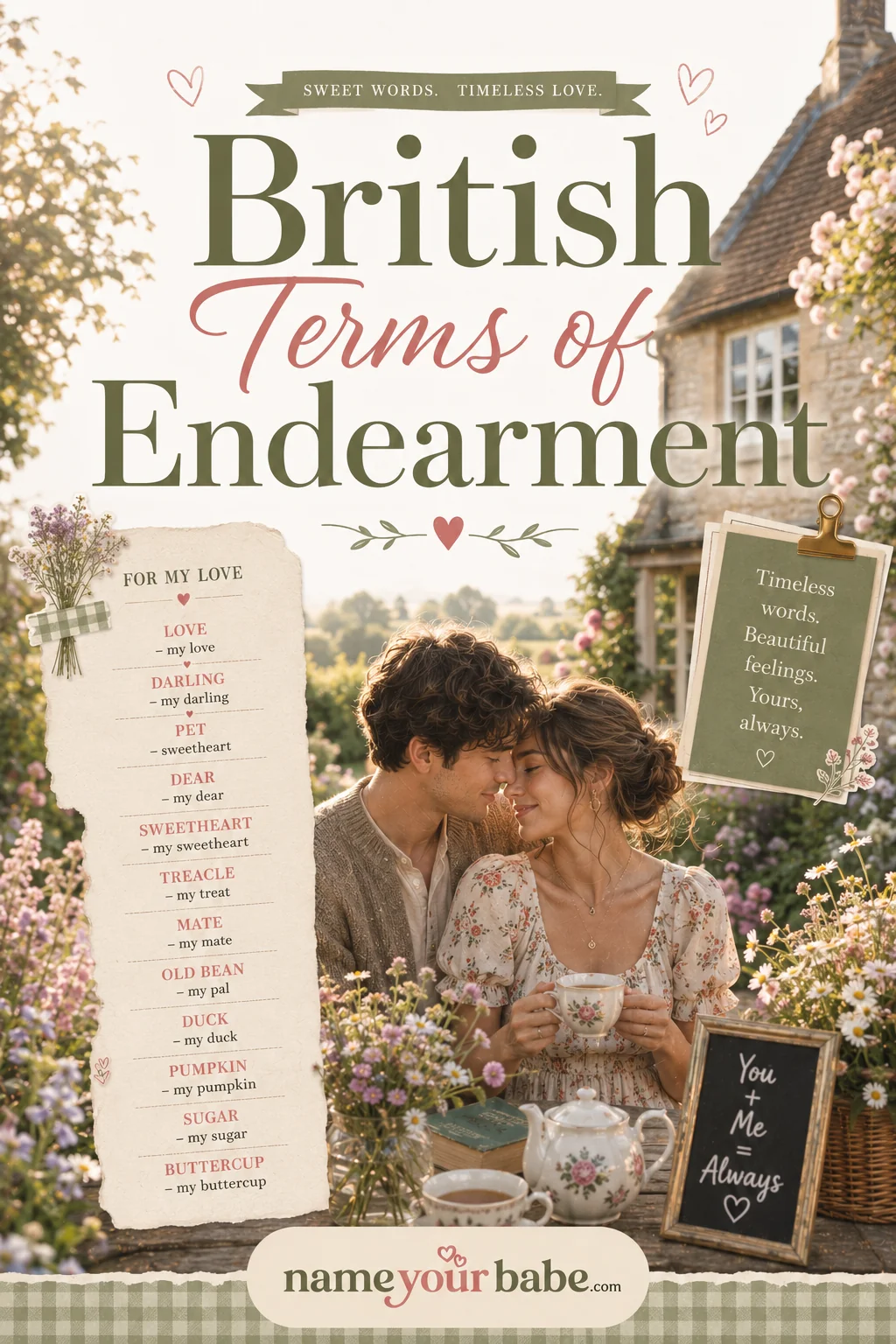
Idioms and pet names come from the same place: the urge to talk about love in a warmer, more playful way than plain words allow. "Lovey-dovey" started as a term of address. "Apple of my eye" works as a nickname, and so does "my better half." If you like the sweetness of these phrases, you might enjoy the history of the word "babe" in our article what does babe mean, or the classic English endearments in British terms of endearment. For a broad overview, see our main guide to terms of endearment.
Wrap-up: the colorful language of love
Love idioms pack centuries of history into a few words. "Head over heels" used to be "heels over head." "Tie the knot" and "pop the question" date to the early 1700s. "Lovey-dovey" began as a pet name, "the apple of my eye" comes from the King James Bible, and "wear your heart on your sleeve" and "the course of true love never did run smooth" come from Shakespeare. Knowing where they came from makes them even more fun to use.
Want a phrase that's just for your person? Try our free nickname generator. You choose who it's for (boyfriend, girlfriend, husband, wife, fiancé or fiancée, crush or partner), pick a vibe like cute and sweet, romantic, funny, flirty, unique or classic, and add optional flavors. Each pick includes a "why it works" note, and you can keep favorites on a shortlist or blend two names with the Couple Name Mixer. For more ideas, try our list of texting nicknames.
Heart Idioms Compared
Many love idioms use the heart. This table lines up seven of them, with what each one means and a note on how it is used.
| Idiom | What it means | Good to know |
|---|---|---|
| Lose your heart to someone | Fall in love with them | Your heart now belongs to someone else |
| Steal someone's heart | Make someone fall in love with you | Often without trying; babies and puppies are said to steal hearts too |
| Your heart skips a beat | You feel a sudden rush of excitement or nerves | Describes the fluttery feeling, often when you see someone you love |
| Pour your heart out | Tell someone all your feelings | Usually at length and with emotion |
| From the bottom of my heart | With complete sincerity | Common in thank-you notes and vows |
| Set your heart on something | Want something very much | "He'd set his heart on proposing at the lake where they met" |
| Have a soft spot for | Feel special affection for someone | Often despite their faults |
Frequently Asked Questions
What are some common love idioms?
Common love idioms include head over heels, which means completely in love; tie the knot, meaning get married; pop the question, meaning propose; puppy love, a young and short-lived crush; lovey-dovey, meaning openly affectionate; the apple of my eye, the person you cherish most; wear your heart on your sleeve, meaning show your feelings openly; carry a torch for someone, meaning keep loving someone who doesn't love you back; and old flame, a former partner. Each has a meaning you can't work out just from its individual words, which is what makes it an idiom.
Why do we say head over heels instead of heels over head?
According to Dictionary.com, the phrase first appeared in the 1300s as heels over head, describing someone literally upside down, which made logical sense. The wording flipped to head over heels in the 1700s, and the phrase took on its figurative meaning of completely in the 1800s. Nobody knows exactly why the illogical version won, but idioms often change shape as people repeat them. Today head over heels is the standard form, and it's used most often in the phrase head over heels in love.
Where does the phrase tie the knot come from?
Tie the knot means to get married, and Dictionary.com dates the idiom to the early 1700s. Knots have long been an image for a strong, lasting bond, which makes the phrase feel natural. You'll often read that it comes from handfasting, a ceremony in which a couple's hands are tied together, or from other knot customs. Those traditions are real in some places, but there's no clear evidence that any single one is the source, so treat those stories as possible influences rather than proven origins.
What does wear your heart on your sleeve mean?
To wear your heart on your sleeve means to show your feelings openly, so everyone can see how you feel. Its most famous early use is in Shakespeare's Othello, where the villain Iago says he would never reveal his true feelings, because then he would wear his heart upon his sleeve for daws to peck at. Daws are jackdaws, small crows. For Iago, showing feelings meant being vulnerable. Today the phrase is usually neutral or even admiring and describes someone who's emotionally honest.
What does the apple of my eye mean?
The apple of my eye means the person you cherish most. The phrase comes from the King James Bible, where Deuteronomy 32:10 says God kept his people as the apple of his eye. In older English, the apple of the eye was the pupil, the round center of the eye that you protect instinctively. So calling someone the apple of your eye means you'd guard them as carefully as your own sight. It's used for partners, children and grandchildren, and it works nicely as an affectionate nickname.
What is the difference between puppy love and a crush?
The two overlap. A crush is a strong, usually short-lived attraction that anyone can have at any age. Puppy love specifically describes a young person's infatuation that isn't expected to last. Dictionary.com notes that puppy love was first recorded in the first half of the 1800s and that British English also calls it calf love. Because puppy love suggests the feelings aren't serious, it can sound dismissive when said about someone else, so it's kinder to use it about yourself when looking back.
Where does the phrase love at first sight come from?
The idea is ancient, but the most famous English line comes from Christopher Marlowe's poem Hero and Leander, which asks, Who ever loved, that loved not at first sight? Shakespeare quoted that line in As You Like It, where the shepherdess Phoebe says, Dead shepherd, now I find thy saw of might, and then repeats Marlowe's question. A saw is a saying. Readers often take the dead shepherd as Shakespeare's tribute to Marlowe. Today love at first sight simply means falling for someone the moment you see them.
What does carry a torch for someone mean?
To carry a torch for someone means to keep loving them even though they don't return your feelings, or long after the relationship has ended. The image is of keeping a flame burning when no one else is tending the fire. It's connected to the term torch song, a sad song about lost or unrequited love, meaning love that isn't returned. It's related to other fire idioms about love in English, such as an old flame for a former partner and the idea of a romantic spark.
When did people start saying pop the question?
Dictionary.com dates pop the question, meaning to propose marriage, to the early 1700s, about the same period as tie the knot. The word pop suggests something sudden and quick, like a cork popping out of a bottle, which captures the nervous moment of a proposal. The idiom never needs to say which question it means, because in this phrase there's only one question anyone has in mind. Today it's used casually, as in He picked Valentine's Day to pop the question.
Are love idioms okay to use in a wedding speech or vows?
Yes, used in moderation they add warmth and humor. A good rule is one idiom per idea, so each phrase does a job, such as moving the story along or naming a feeling. Casual idioms like get hitched suit a relaxed toast, while literary lines like Shakespeare's the course of true love never did run smooth fit a more formal speech. Avoid phrases that could sound dismissive, such as puppy love about the couple, and skip idioms your audience may not know unless you briefly explain them.
Sources
We checked every source below while writing this guide. Last reviewed October 30, 2026, by Joan Ramos.
- Head over heels (Dictionary.com)
- Tie the knot (Dictionary.com)
- Puppy love (Dictionary.com)
- Lovey-dovey (Dictionary.com)
- Pop the question (Dictionary.com)
- Othello, Act 1, Scene 1 (Folger Shakespeare Library)
- A Midsummer Night's Dream, Act 1, Scene 1 (Folger Shakespeare Library)
- As You Like It, Act 3, Scene 5 (Folger Shakespeare Library)
- Hero and Leander by Christopher Marlowe (eBook #18781) (Project Gutenberg)
- Deuteronomy 32:10 (King James Version) (Blue Letter Bible)